Showing posts with label Apples. Show all posts

Monday, 12 October 2015

Tree following October.

There has not been much change during the last two months, in the Acer negundo Flamingo I have been following this year.
 If you haven't visited before, here it is growing in the Oriental Garden.


 I pollard it every January Here  to prevent it becoming too big while encouraging the slate blue branches and fine pink stems that you can see in the pictures, to develop.


Unfortunately the white variegated edges of the leaves have been scorched by either the sun or more likely the wind.


I thought this was a good time to introduce you to the never ending woodland path here at Our Garden19. Walking through the main borders towards the Banana Bench...


...you come to the start of the path, here you have a choice to make, left or right?


I seem to nearly always turn to the left, I don't know why, passing the Boston Ivy (Parthenocissus tripcuspidata) on the trellis just turning red and the apple 'Kid's Orange Red' on your left.


Boston Ivy
It is, I think, a lovely eating apple.


Following the path round behind the bench...


...you pass Rose glauca.syn. Rose rubrifolia...


...and Sorbus Eastern Promise, both growing through Aucuba, Dogwoods, and a variegated Holly backed by a Sambucus nigra.


A little further round you have Ligularia przewalskii, on the right, behind the Banana Bench trellis, this produces lovely spires of yellow flowers. Hiding in the corner of this picture is an apple tree Worcester Pearmain, we had to have one of those.
The first tree on the left is Liquidamber slyraciflua 'Stella'...


...whose leaves are just starting to turn a 'buttery' yellow, soon to turn red...


...a little further along the never ending path is what I refer to as our 'Champion Tree', the Prunus serrula...


...with its wonderful coppery peeling bark.


And here we emerge, back where we started in front of the Banana Bench where you can sit and rest looking out over the garden before you start again following the never ending woodland walk.


On your way back to the house if you look over the fence you can see the neighbours' Liquidamber in all its Autumn fiery glory...


...every year it turns earlier than the one in our garden, which means we can enjoy theirs before ours puts on a show.


The last picture is a close up of a Boston Ivy leaf.


If you wish to see which trees other bloggers are following please visit Lucy at Loose and leafy Here

Please click on any photo to create a slide show.

Saturday, 22 August 2015

Waterperry Gardens.

On a beautiful, sunny day, we visited the Waterperry Gardens, Oxford, with:

The gardens can best be described in the words of committee member Lorna Winstone,

"On Monday 17th August the Black Pear Gardening Club members visited  Waterperry Gardens in Oxfordshire. Founded as a school of horticulture for ladies by Beatrix Havergal in the 1930’s and run by her  with  Avice Sanders until  her retirement in 1971, Waterperry House is surrounded by eight acres of landscaped ornamental gardens and interesting buildings such as the Saxon church and the museum of rural life.  The gardens are open all year round and it was easy to see how various plants would be at their best in the different seasons. The famous herbaceous borders were planted using just herbaceous plants, following the principles of design popularised by Gertrude Jekyll so that there are three distinct periods of flowering beginning in May and June with Lupins, Anchusia, Geraniums, Pyrethrum and Veronica. These are followed in July and August by Delphinium, Achillea, Verbascum and Phlox. In autumn there will be a third flush of colour from Michaelmas daisies, Goldenrod and Heleniums.
The gardens also contained mixed borders such as the Long Walk and Island Beds designed by Alan Bloom in 1968. The flowers and grasses, of course, looked spectacular in the summer sunshine and provided some excellent  photo opportunities for those of us who like taking photos.
There were a number of statues used very effectively to enhance areas of the garden such as the Canal and Miranda’s Border, the Formal garden and the Virgin’s walk.
The nursery stockbeds provide a living catalogue of plants and were used to show how different varieties compare with each other, as well as providing a source of propagation material for the gardens and the garden centre on site. The orchards also provide apples and pears sold in the shop in the autumn and apple juice that is sold all year long.
As with any successful venue for a gardening coach trip the food and drink provided by Miss H’s Teashop was excellent."

The entrance to the garden is through the plant centre, which many of our members struggled to resist so early in the day!


You entered via a gate in the garden wall past a Pelargonium Theatre...


The famous Herbaceous border, from the right...


...and the left...

...and the centre.


One of the Island Beds.

I was fortunate to find head gardener Pat Havers and a volunteer working on this rose border.
They explained the roses are all rambling forms, trained into arching branches tied down to bent hazel stakes. The only other garden where this is done is Sissinghurst.
This was the only rose flowering in August, it must be a very impressive site when they are all in flower.


The Water Lily Canal and Miranda's Border.
The statue of Miranda from Shakespeare's 'The Tempest', the border colour scheme is red and yellow, planted in the spring with Tulips and Wallflowers followed by Dahlias and Rudbeckias for the  summer.


A formal entrance to the...


...Mary Rose garden, which comprises two sections, one containing modern cultivars, the other planted with species, shrub and old fashioned roses.


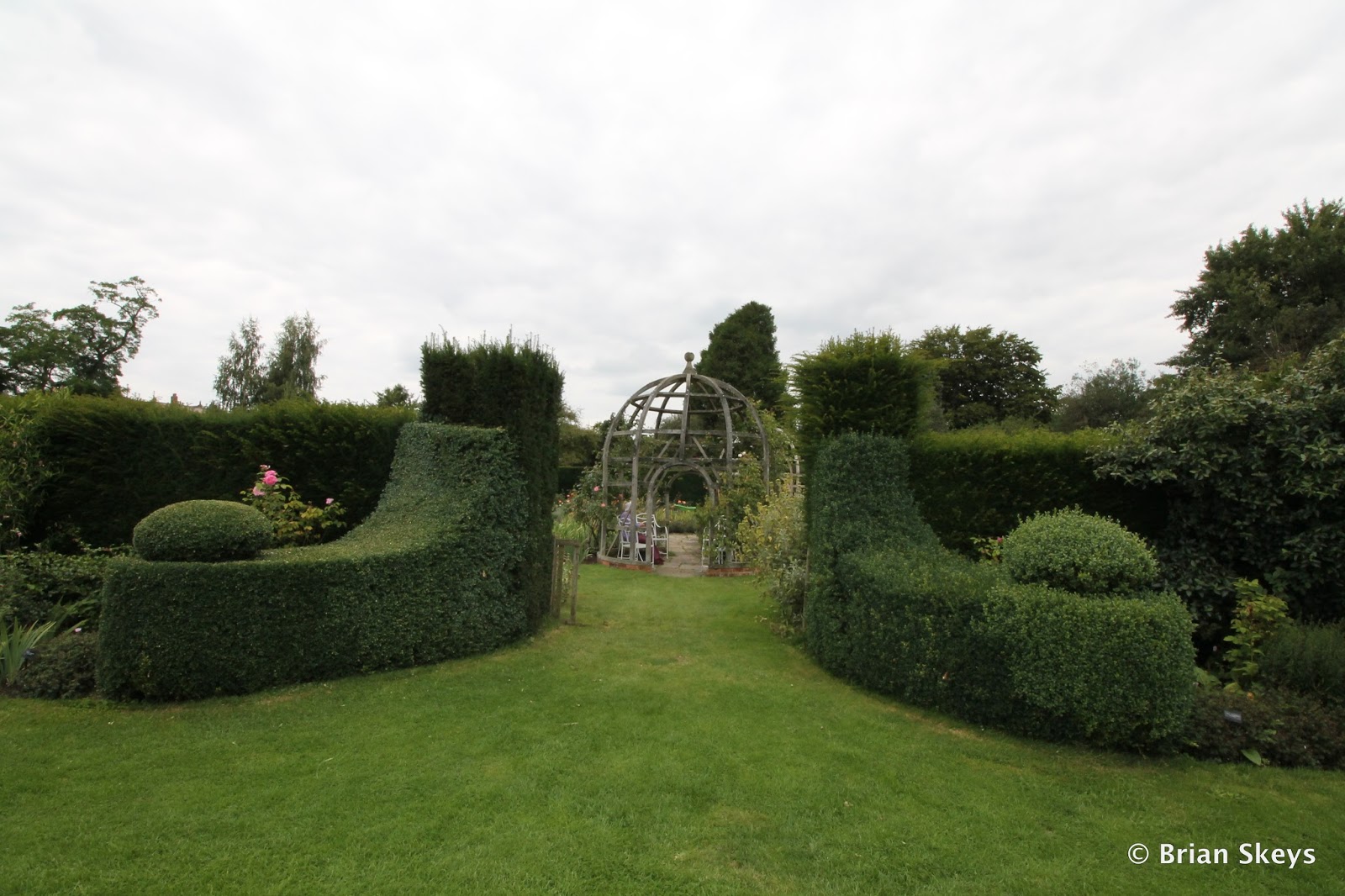
There are many formal views and ornaments around the garden.


The long walk with its colour themed mixed borders.


There are five acres of orchard growing around sixty different varieties, producing apples, juice and now cider to sell in the garden shop.
This photo is of the 'Family apple tree' created in 2010 by grafting different varieties on to a twenty five year old Spartan 'mother tree'.
The aim is to eventually graft all sixty varieties on to the tree!


A peaceful walk alongside the river Thame, a tributary of the Thames...


...before leaving the garden through the Saxifrage Garden which contains The Plant Heritage National Collection of Kabschia Saxifrages.


This class room greenhouse is a reminder that horticultural teaching still continues today.


The museum is full of rural antiquities, all very well presented.


All our club members who visited Waterperry Gardens came home very impressed with the gardens, museum and the tea room refreshments.
We shall certainly be making a return visit some time in the future.

Please click on any picture to create a slide show.

Friday, 8 May 2015

Tree following. May

 The buds on the Acer negundo Flamingo that I have chosen for the tree following meme are now fully open revealing their pink edging. 


Worcestershire has long history of Fruit Blossom Trails.
I thought, as a seasonal extra, I would show you some of the blossom on our fruit trees.  This has been exceptionally good this year.

Please follow the Blossom Trail in Our Garden@19.

Crab Apple 'Golden Hornet'

Espalier trained Pear 'Invincible' growing over an arch.

Pyrus 'Invicible'

Fan trained Cherry 'Sunburst'.
Prunus 'Sunburst'
Espalier Apple 'Blenheim Orange'
Malus 'Blenheim Orange'
Malus 'Grenadier'


Malus 'Roseette'
Malus 'Kidd's Orange Red'
Malus 'Worcester Pearmain'


Malus ' Herefordshire Russett'

All these trees have been planted in the garden since 2004, when we bought the house.

I hope you have enjoyed our Blossom Trail, we hope for no late frosts and a good fruit crop.

Please click on any photo to create a slide show.

The answer to April's tree following bark quiz is: Cedar of Lebanon (Cedrus libani)

To visit other blogs Tree following click on the link to Lucy Corrander's Blog Loose & Leafy http://looseandleafy.blogspot.co.uk