Wednesday, 17 February 2016

Spring was in the air. (Garden bloggers bloom day February 2016)


Today sees a return of wet, wintery weather here in Worcestershire.
I took some photographs of what was flowering in the garden two days ago when the sun was shinning. 
In the Alpine boxes, by the front door, Ipheion 'Albert Castillo' was in full flower (they are lay flat today).


Alongside are pots of heathers and dwarf pines (harking back to the seventies!)


Also catching the sun is the Sarcococca, Christmas Box, which didn't start flowering here until the end of January, the scent is so powerful, you can smell it every time the front door is open.


In the main borders, Narcissus 'Tete-a-Tete' is flowering,


and the honey bees are visiting the Crocus tommasinianus, you can actually see the pollen on the bees legs.


There are a few yellow crocus in pots, these seem to be getting less each year. (mice?)


Pulmonaria 'Blue Mist' is a welcome sight along side the path. 


Underneath a dogwood there are groups of snowdrops...


...this one looks different from the others?


...They are joined by a solitary N. 'Jumblie'.


The Leucojum aestivum, is one of my favourite flowers at this time of year, I don't know why it is called the Summer Snowflake.


The dark slatey purple hellebores are usually the last to flower, these along with many of our garden plants came with us from our previous garden. They were bought from what was then a very good local nursery as H. orientalis purpurea.


Corydalis cheilanthifolia is new to the garden.  I admired it growing in the wall of a friends garden and was told to help myself, it can apparently be invasive, so I have it in a pot and
 it flowers for months with lovely fern like leaves.


The Kerria japonica 'Pleniflora'  (Batchelor's Buttons) is according to the RHS a mid spring flowering shrub, it has had flowers here for over a month.


Last night I gave a slide presentation to the Gloucestershire Organic Gardening Club, a lovely, welcoming, very active group of gardeners. What was a bonus was the plant stall selling snowdrops, I couldn't resist 'investing' some of my fee in these two beauties...


The large robust Galanthus elwesii


and the lovely dimpled petaled G. plicates 'Augustus'.


I blame Anna at Greentapestry Here for stimulating this addiction.
You have been warned if you visit by clicking the link.
I am also linking to Carol at Maydreamgardens.com for garden bloggers bloom day Here where you can see what is blooming in gardens during February around the world.

Please click on any picture to create a slide show.


Sunday, 7 February 2016

Tree following February 2016 (Worcester Pearmain).


The tree following meme hosted this year by Pat at 'The Squirrel Basket' is followed by bloggers from around the world. I am joining in again this year by following a Malus domestica 'Worcester Pearmain', growing in our community orchard.


The Worcester Pearmain was developed by a Mr Hale from Swanpool, Worcester. Swan pool is an area in St Johns, Worcester.

It is a tip bearing tree, carrying the fruit on the end of stems rather than spur bearing, this has to be taken into consideration when pruning.


It is partially self fertile bearing heavy crops of sweet, strawberry flavoured fruit with only short keeping quality and it can also be cooked.


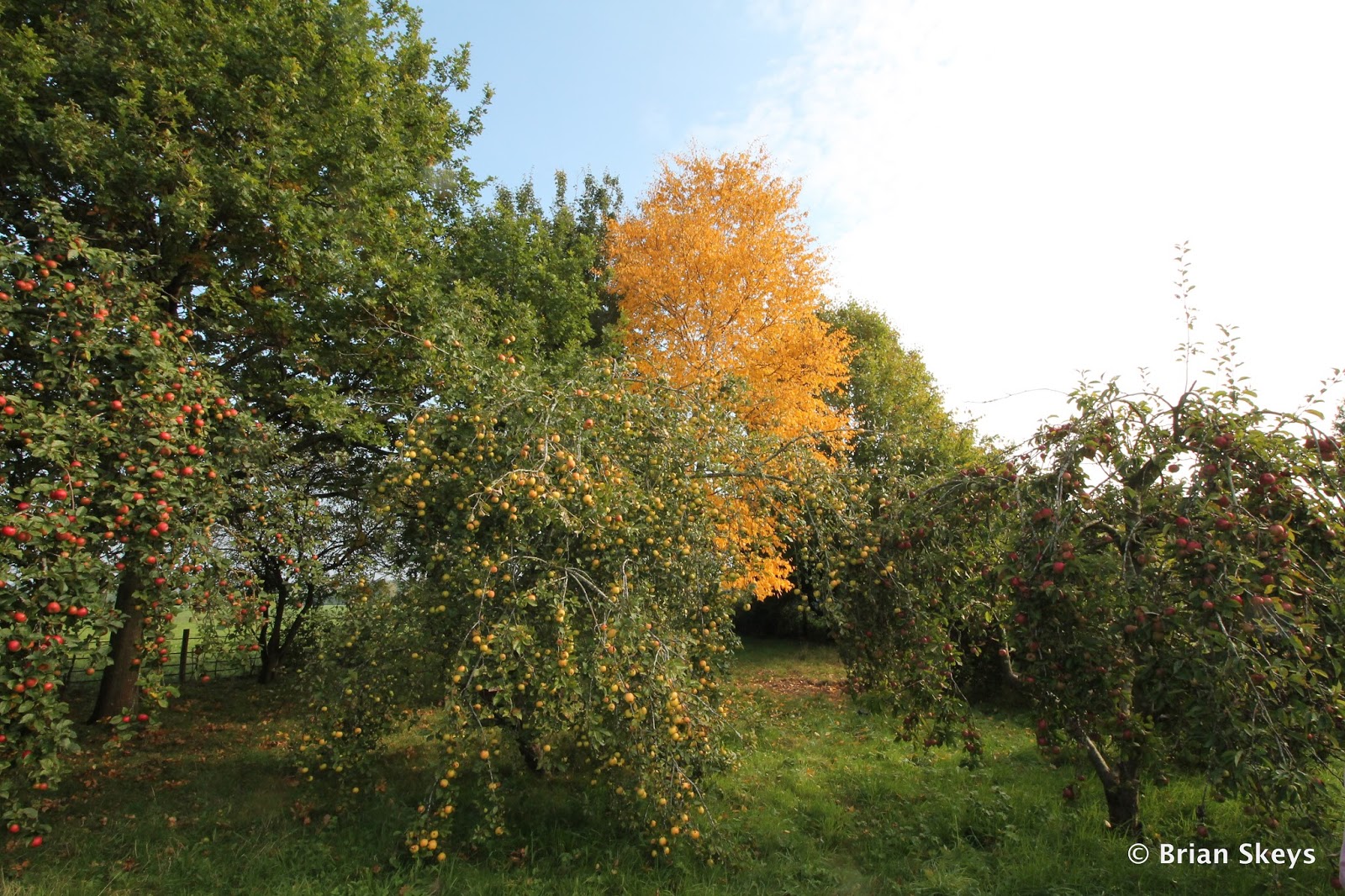
I visited the orchard, in October, on fruit picking day and took some photographs.
These pictures, above and below,  are of the Worcester tree and fruit.


The history of the Community Orchard was written by Hanley Swan resident, Val Fare, and is printed on the apple juice labels.  I have copied it here for you:

" In 1982 John and Vera bought a field near their home in Hanley Swan. The previous owner took his horse elsewhere and John and Vera planted strawberries. As they didn't believe in artificial pesticides or fertilisers they lost out to slugs and birds.
So in 1983 they planted an orchard, mainly apples, mainly old varieties such as Ashmeads Kernel, Ribston Pippin, Egremont Russet, Peasegood Nonsuch, Allington Pippin and Kidd’s Orange Red.
The orchard thrived,  the trees grew as did the primroses, violets, ox daises and wild orchids and John and Vera ate or gave away the apples.
In 2002 John died but Vera carried on tending the orchard until 2013 when, in her late 80s, she could neither digest the apples nor scamper up the ladder to pick the huge crop. She could not bear the waste. What was to be done…
Neighbours in Hanley Swan heard of Vera’s dilemma and one sunny morning that October villagers of all ages met to pick her apples, more than half a ton. They were pressed and bottled at Clives Fruit Farm nearby, labelled by volunteers and all sold within six weeks.
At Vera’s instigation we are making her orchard a community orchard, benefitting the whole community in the Hanleys and apple juice lovers everywhere.
The juice from the 2014 crop of our apples also sold out. And our villagers so liked the concept of our orchard that this year, 2015 many of them have donated their apples to make another juice from the little orchards of the Hanleys and their environs. So now we have a sister juice also available.
All profits from both juices go to the upkeep of our community orchard."


The previous day we had picked the apples from 'The Little Orchards'.

I will leave you with some of the pictures taken at Vera's Orchard on picking day.


The Worcester laden with fruit.


The first of many...

I will be visiting the orchard during the year to record and publish the changes throughout the seasons.

To see what trees other bloggers from around the world are following please visit 'The Squirrel basket': Here

Please click on any picture to create a slide show.

Thursday, 28 January 2016

Medinilla Magnifica.

In 2008 we visited the Royal Greenhouse in Belgium.
 The Belgian Royal Greenhouses are situated just outside Brussels at The Royal Family's Summer residence at Laeken.

 The greenhouses at Laeken are open for 3 weekends only in May and the monies raised go to charity.  The third weekend is for disabled people only.
 Built between 1874 and 1905 by King Leopold 2nd, who had a special love of plants and flowers.
The Winter Garden Dome, 25.6 m high is supported by 36 pillars, constructed between 1874—76, 
it required 651.5 tons of steel.


 There is a Palm greenhouse built between 1892—95 and a Congo greenhouse.  The King was fascinated by the mystery of Central Africa with its exotic fauna and flora and its wealth of ivory, copper, rubber and tropical hardwoods. 
By the time of Leopold's death the royal greenhouses were the largest and housed the most remarkable private botanical garden in the world.
The Belgian Congo was transferred from being a royal possession to a Belgian colony in 1908 and remained so until 1960.


One of the plants that caught our eye was Medinilla Magnifica, seen here inside the Embarcardair 
greenhouse... 


   ...it is a tropical plant from the forests of Java and the Philippines, the large ones in the greenhouses are more than 30 years old.


 The Chinese vases were brought back from the Far East around 1860 by Leopold 2nd.


We had not visited a Garden Centre since well before the Christmas madness. 
Tempted by a 2 for 1 breakfast offer and a voucher of £1.81 (I know, I am easily led!) and telling myself it was too wet to do anything in the garden, we enjoyed a very good breakfast.  The  restaurant was packed and everyone appeared to have the breakfast voucher.
While needing nothing much for the garden? we went in separate directions, me to look for seed potatoes and bird food, Irene to the deli and to admire the orchids where she found...
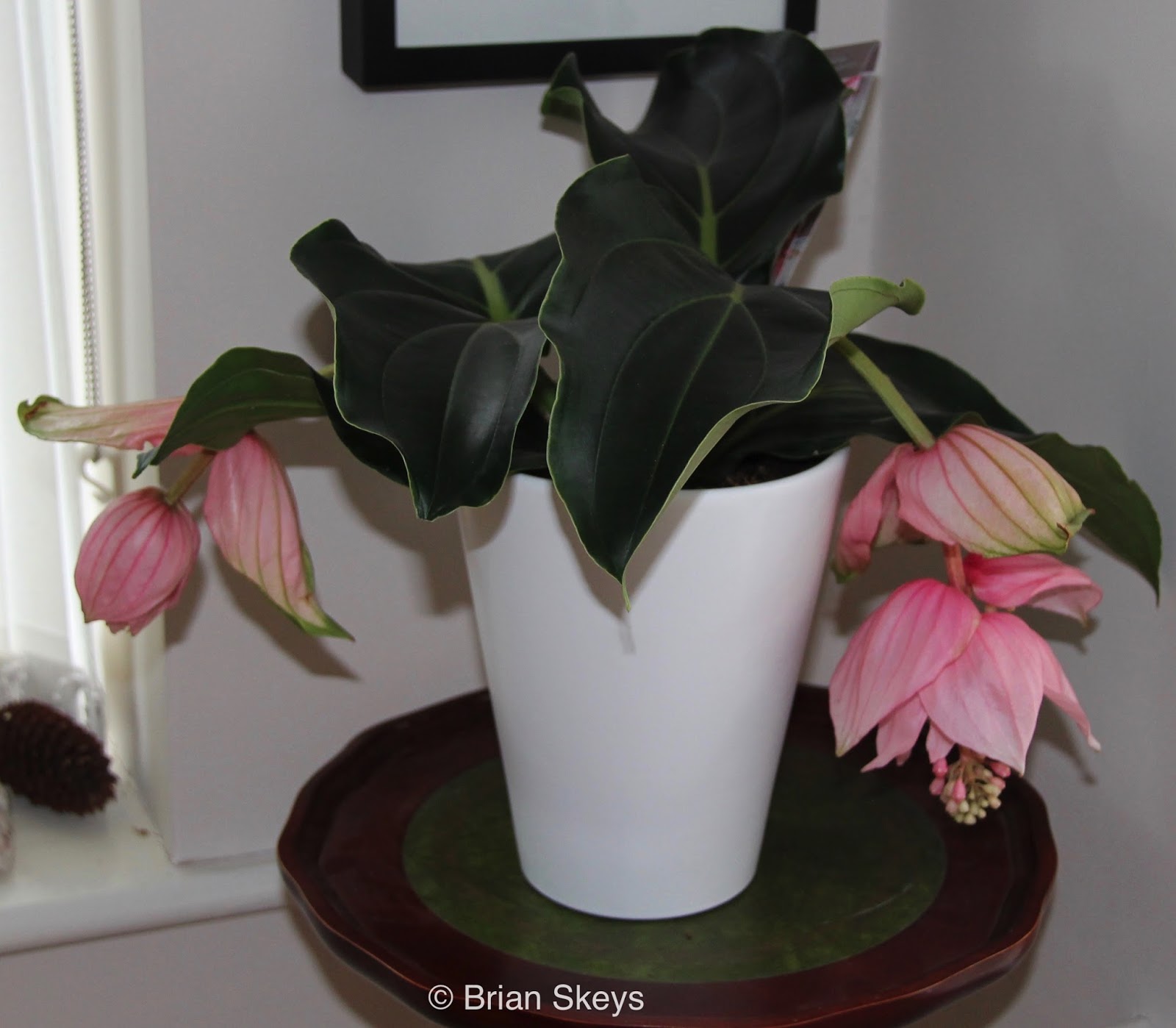
Medinilla Magnifica plants for sale, well...

one had to come home and take pride of place in the corner of the dinning room.


I know some of my fellow bloggers have taken the pledge not to purchase any plants this year, 
not something I could do!
Have you been tempted?

Please click on any picture to create a slide show.

I have a slide show presentation based on our visit to Belgium.